The short answer
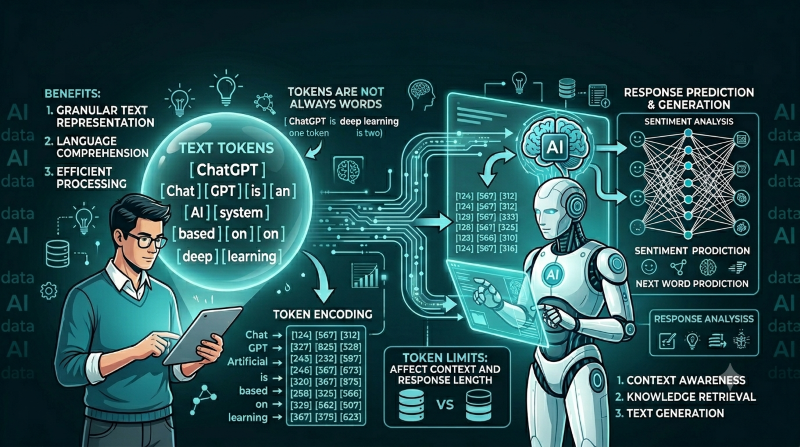
An AI token is a chunk of text that an AI model uses internally. It can be a full word, part of a word, a number, punctuation, a space pattern, or another small text fragment. When you type a prompt into an AI tool, the model does not usually process the sentence exactly the way a human sees it. First, the text is broken into tokens. The model then predicts the next useful tokens to produce the answer.
For everyday planning, you can think of tokens as the measuring units behind AI text. Words are familiar to people, characters are familiar to computers, and tokens sit in the middle. They are close enough to text that writers and product builders can estimate them, but structured enough that models can use them for prediction. That is why token counts appear in AI API pricing, context limits, prompt size warnings, and usage dashboards.
A rough English estimate is that one token is about four characters, or that 100 words might become around 130 tokens. This is only a planning shortcut. The exact count changes depending on the model, the tokenizer, the language, the spelling, the punctuation, and the mix of numbers or symbols. Still, this rule of thumb is useful when you are deciding whether a prompt is tiny, normal, long, or too large for the model you want to use.
Why AI models use tokens instead of words
Words look simple until software has to handle every possible language, typo, domain term, code sample, URL, emoji, number, and punctuation mark. If a model only understood whole words, it would struggle with words it had not seen before. If it only understood individual characters, every sentence would become very long and less efficient to process. Tokens are a practical compromise.
Tokenization lets a model represent common text pieces compactly while still handling unusual text. A frequent word might be stored as one token. A rare technical word might be split into several smaller tokens. A made-up product name can still be processed because it can be broken into recognizable fragments. The model does not need a perfect dictionary of every word ever written; it needs a consistent way to break text into manageable pieces.
This is also why the same sentence may produce different token counts across AI systems. Tokenizers are designed differently. One model may split a word one way, while another model may split it another way. From a user perspective, the difference is usually small for normal English paragraphs, but it matters when you are doing precise API cost planning, fitting text into a context window, or comparing providers.
Tokens are not the same as words
A common beginner mistake is assuming that one word always equals one token. Sometimes that is true. Often it is not. A short, common word such as "the" may be one token. A longer word such as "internationalization" may be split into several tokens. A contraction, hyphenated phrase, code variable, or unusual spelling may also split in ways that are not obvious from a normal word count.
Punctuation can count too. A period, comma, quotation mark, newline, or bullet marker may become part of a token or a token on its own depending on the surrounding text. Numbers can be split into chunks. A URL can become many tokens because it includes symbols, slashes, dots, and mixed words. Code can become token-heavy because variable names, indentation, operators, and punctuation all add structure the model must read.
This does not mean word counts are useless. Word count is still a helpful human-facing measurement. It tells you whether a paragraph is short, whether an article is long, and whether a response will feel concise. Token count is the model-facing measurement. It tells you how much the AI system must process and how much the API may charge. Good AI workflows pay attention to both.
Input tokens and output tokens
There are two token directions to understand: input and output. Input tokens are the tokens you send to the model. They include your visible prompt, system instructions, developer instructions, chat history, retrieved documents, examples, formatting rules, tool definitions, and any hidden template text your app adds before the request reaches the model.
Output tokens are the tokens the model generates in response. If you ask for a one-line answer, output tokens may be small. If you ask for a detailed guide, a long email, code, a table, or several options, output tokens increase. Many AI APIs price input and output tokens differently, so the split matters. A workflow with a large knowledge base snippet and a short answer has a different cost shape from a workflow with a tiny prompt and a long generated report.
When people say "this prompt used 2,000 tokens," they may mean total tokens, but for planning you should keep the two sides separate. Input tokens affect how much context the model can consider. Output tokens affect how much room the model has to answer. Together, they affect cost, speed, and whether the request fits inside the model limit.
Count tokens before you send a long prompt
Use our free tools to estimate prompt size, compare text length, and plan API usage before a workflow becomes expensive or difficult to debug.
Open Word and Token CounterContext windows explained
The context window is the maximum amount of text the model can consider in one request. It is usually described in tokens. If a model has a context window of a certain size, the input tokens and output tokens must fit within that available space. You cannot keep adding documents, chat history, and instructions forever. At some point, older or less important text must be removed, summarized, compressed, or left out.
This is why long chats sometimes lose track of earlier details. The app may trim old messages to keep the conversation inside the context limit. It is also why document-based AI tools need retrieval. Instead of pasting an entire library into the prompt, the app searches for the most relevant chunks and sends only those pieces. Token limits force AI products to be selective.
A bigger context window can be useful, but it is not a magic quality button. More context can help when the extra text is relevant. It can hurt when the prompt becomes noisy, repetitive, or contradictory. A clean 2,000-token prompt may outperform a messy 20,000-token prompt if the shorter prompt contains the right details. Token planning is not only about fitting more text; it is about choosing the text that deserves the model's attention.
How tokens affect AI API cost
Most text AI APIs charge by token usage. A provider might list prices per thousand tokens, per million tokens, or another unit, but the idea is the same: the more tokens your app sends and receives, the more usage you create. This is why a prototype can feel nearly free while a production app can become expensive. One request is small. Thousands of long requests per day are not small.
Imagine a writing assistant that sends a user's draft, style instructions, examples, and a request for improvement. If the draft is 1,500 words, the input may be several thousand tokens before the model writes anything. If the assistant then returns a rewritten version, the output may be another few thousand tokens. One polished response can be worth it, but it should be priced as the full workflow, not as a single sentence.
The easiest planning formula is simple: estimate input tokens, estimate output tokens, multiply each by the model's unit price, then multiply by expected usage. If your app has retries, regenerations, background checks, or multi-step chains, include those too. A customer may click one button, but your system might call the model several times behind that button.
If you want a more direct budget estimate, use the AI API Cost Calculator. It is especially helpful when you know the prompt size, expected response size, daily call volume, and monthly budget target. The point is not to predict the invoice perfectly. The point is to make the cost visible early enough to make better product choices.
Why token counts change by language and format
Token estimates are often explained with English examples, but text is global. Different languages can produce different token patterns. Some languages use spaces between words, some do not. Some scripts may be represented more compactly or less compactly depending on the tokenizer. A short sentence in one language may use more tokens than a visually similar sentence in another language.
Format matters too. Plain paragraphs are usually easier to estimate. Tables, Markdown, JSON, HTML, logs, CSV files, and code can be more token-dense because they contain repeated symbols and structural markers. A short JSON object may contain many punctuation tokens. A stack trace may include file paths, line numbers, brackets, and symbols. A URL list can become surprisingly large.
If your users work with code, data, multilingual text, legal clauses, medical notes, transcripts, or product catalogs, do not rely only on generic English rules. Test realistic samples. Count a normal case, a long case, and a difficult case. Your token budget should be based on the content your users actually paste, upload, or generate.
Prompt design is token design
Every prompt decision changes token usage. A short instruction can save tokens, but an instruction that is too vague may produce poor answers and more retries. A long instruction can guide the model better, but it may waste space if it repeats obvious rules. Good prompt design balances clarity with length. The goal is not to make prompts tiny at any cost. The goal is to spend tokens where they improve the result.
For example, a support assistant may need brand tone, refund policy, shipping rules, and customer context. Those tokens are useful if they help the answer become accurate. But if the prompt includes old policies, duplicate instructions, or unrelated examples, those tokens add cost without adding quality. Prompt cleanup is a practical performance task, not just a writing preference.
Few-shot examples are a good place to be deliberate. Examples can teach the model the desired format, tone, and reasoning pattern. They also consume input tokens every time they are sent. If one example works nearly as well as five, the shorter prompt may be better. If five examples prevent serious errors, they may be worth the extra tokens. The right answer depends on test results, not guesswork.
Common token mistakes
The first mistake is counting only the user's latest message. In many apps, the visible user message is only a small part of the request. The full prompt may include hidden instructions, chat history, retrieved documents, and output formatting rules. If you ignore those pieces, your estimates will look much cheaper than reality.
The second mistake is setting a very high output limit without thinking about the product experience. A generous limit can be useful for deep analysis, but it may allow rambling answers for simple tasks. Short tasks need short limits. Long tasks need enough room to finish properly. The best limit is based on the actual job the user is trying to complete.
The third mistake is treating all models as if they tokenize and price text the same way. They do not. A prompt that fits one model may need changes for another. A workflow that is affordable on one model may become expensive on another if output is long or pricing is different. When switching models, re-check the token count, context limit, quality, speed, and budget.
Practical ways to manage tokens
Start by making token usage visible. Log input tokens, output tokens, model name, workflow name, and request outcome. Over time, this tells you which features consume the most tokens and which prompts are growing. Without measurement, token optimization becomes guesswork. With measurement, you can fix the expensive parts first.
- Keep reusable instructions concise and remove duplicate rules.
- Send only the conversation history needed for the current answer.
- Retrieve fewer, better document chunks instead of many weak matches.
- Set output limits that match the expected response type.
- Summarize long background context when exact wording is not required.
- Use smaller or cheaper models for simple classification and cleanup tasks.
- Test prompts with realistic samples before launching a high-volume workflow.
Token management should not make your product feel cramped. Users still need useful answers. The point is to remove waste: stale context, unnecessary repetition, oversized examples, and unlimited responses where concise output would be better. A well-designed AI workflow often becomes faster, cheaper, and clearer at the same time.
A simple mental model
Think of tokens as the model's reading and writing budget. Input tokens are what you ask the model to read. Output tokens are what you allow it to write. The context window is the size of the desk where all that text must fit. API pricing is the meter that records how much reading and writing happened.
This mental model makes AI behavior easier to reason about. If the answer misses a detail, maybe the detail was never included in the input. If the answer stops early, maybe the output limit was too low. If the cost is high, maybe the prompt sends too much history or asks for long responses. If the app feels slow, maybe the model is processing more tokens than the task deserves.
You do not need to become a tokenizer expert to build better AI features. You only need to remember that tokens are the unit behind prompt size, response size, context limits, and cost. Once you can estimate them, you can make better choices: shorter prompts when possible, richer context when necessary, clearer output limits, and budgets that match real usage.
Final takeaway
An AI token is not mysterious. It is a small piece of text that helps a model convert human language into something it can process and generate. Tokens explain why two prompts with the same word count can cost different amounts, why long chat history matters, why context windows have limits, and why output length should be designed rather than left open-ended.
If you are writing prompts casually, a rough token estimate is enough. If you are building an app, charging customers, planning API usage, or processing long documents, token awareness becomes essential. Count realistic samples, separate input from output, watch hidden prompt text, and review real usage after launch. That habit turns tokens from a confusing technical detail into a practical tool for building AI workflows that are useful, affordable, and easier to maintain.